A weekly newsletter from the Institute for Policy Studies |
|
|
How do you celebrate a country run
by oligarchs? Put people first. |
|
|
|
How are you marking the big 2-5-0 this Saturday? Fireworks? A little fife and drum? Just another day? Here in the U.S. capital, I’m taking a pass on Donald Trump’s “Great American State Fair” on the National Mall. I’ll let others gawk at his model for a proposed new “Triumphal Arch.”
But I did check out an exhibition at the nearby Library of Congress. This 250th event doesn’t gloss over our colonial history’s dark side. Displays feature newspaper ads that George Washington, our “nation’s father,” placed back in the day. The ads offer bounties for the return of his escaped slaves.
At this historic moment, I’d like to salute all the enslaved who dared to flee their captors — and all those who dared to aid in their escapes. I’d like to salute not just the revolutionaries of 1776, but all those who’ve risen up against economic tyranny in the years since. The workers who’ve battled for union rights. The activists who’ve taken great risks to combat discrimination of every sort.
These fighters for our inalienable rights to life, liberty and the pursuit of happiness stand as our American history’s real heroes. Pretty self-evident, don’t you think? Sarah Anderson
for the Institute for Policy Studies Inequality.org team |
|
|
|
Confronting the Ugly Secret Behind the Silk and Lace of Victoria’s Secret This week’s frontline face: Prarthana Gurung, a senior garment campaign organizer at Global Labor Justice, pictured above in the green shirt.
What she’s doing to help create a more equal world: Gurung is pushing global brands like Victoria’s Secret to crack down on gender-based violence and harassment in their supply chains. Last year, a worker producing Victoria’s Secret apparel in a Sri Lanka factory, Paramasivam Pushpalatha, fell ill and requested medical leave. But her manager ordered her to finish her shift. Pushpalatha died just hours later. A union organizer leafleting about the incident later found herself confronted by men wearing shirts with the supplier company’s logo. They threatened her with rape and murder. Pushpalatha’s family has also faced intimidation.
Gurung recently helped lead a protest outside a flagship Victoria’s Secret in New York City. The protesters demanded that the company sign agreements with its suppliers that ensure basic rights to the women who make the products Victoria’s Secret sells, including the right to report and eliminate gender-based violence.
What makes this fight so important to her: Gender-based violence and harassment have become “a pervasive part of the global garment supply chains,” Garang explains in a new interview with Inequality.org.
“When a worker like Pushpalatha” she adds, “is unable to take medical leave when feeling ill, when union organizers are threatened with rape for handing out flyers, and when a grieving husband is warned to stay quiet or risk 'an accident,’ Victoria's Secret has an obligation to take action.” |
On This Historic Anniversary, Let’s Truly Embrace ‘We the People’
Celebrating America can be hard enough in an average year. But getting into a celebratory mood for our 250th anniversary as our federal government brutally cracks down on our immigrant neighbors at home and funds an ever-expanding genocide in Palestine and Lebanon can seem like an impossible task.
In a new blog, communications strategists Michael Chameides, Meg Bostrom, and Elaine Mejia suggest going back to America's founding for inspiration. In the famous words "We the People," the trio note, Americans now can find a powerful promise worth fighting for.
Putting the people — not billionaire oligarchs and their bought-out politicos — back in charge won’t be easy. But it’s already happening all across the country, via mobilizations that range from local campaigns against data centers to rural community battles for environmental protections. "We the People" can be so much more than just mere words. |
PETULANT PLUTOCRAT OF THE WEEK |
Could This Billionaire Eventually Become MAGA’s Philosopher King?
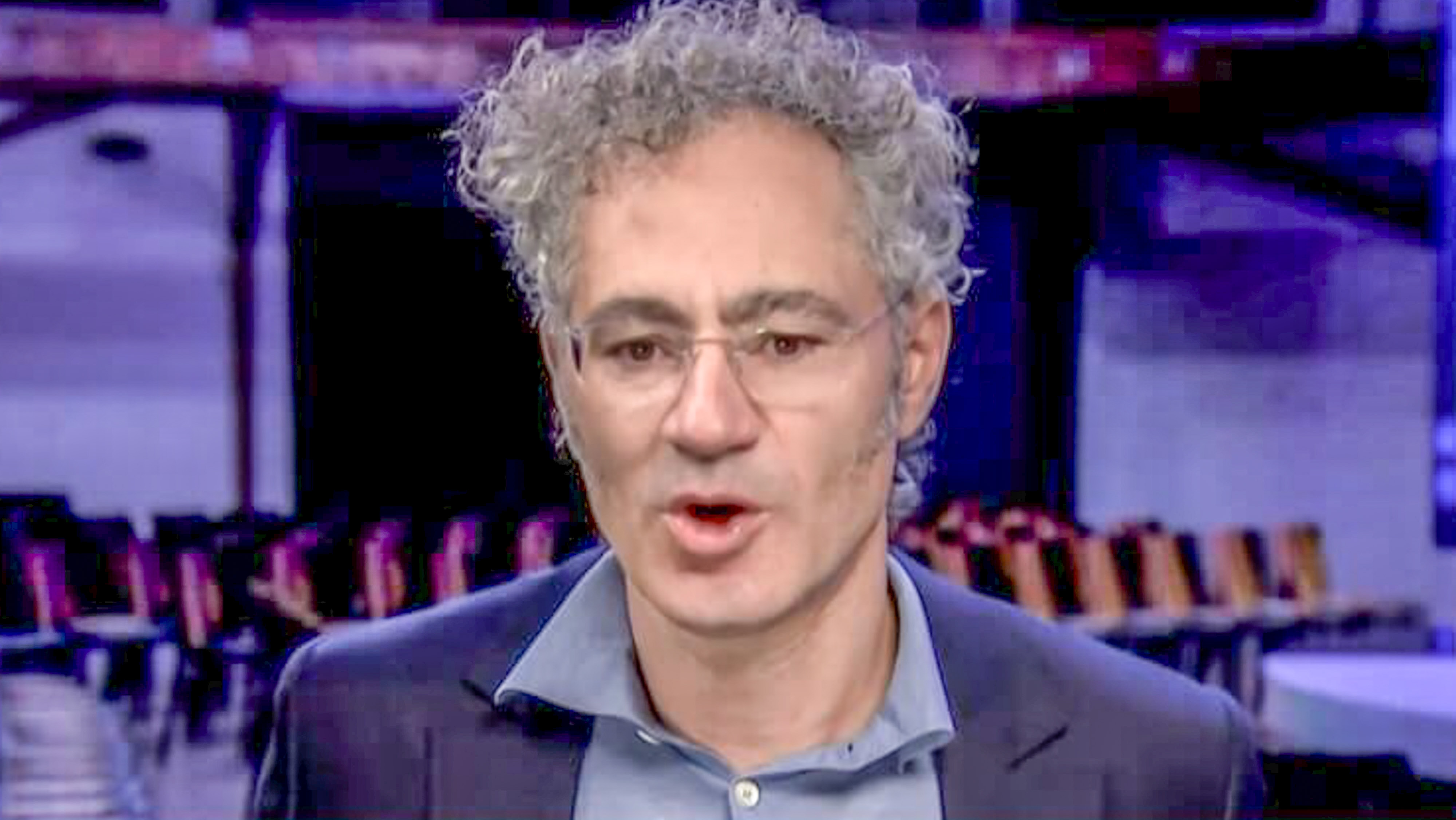
This week’s dour deep pocket: Alex Karp, the 58-year-old chief executive of Palantir Technologies, an enterprise software provider — now deep into AI — that he co-founded with, among others, Peter Thiel, the ultra-secretive billionaire right-wing activist investor.
What has Karp sour: any hint that he doesn’t rate as a deep thinker.
Karp as a young man actually studied with one of our last century’s deepest thinkers, Jürgen Habermas, the German philosopher who died this past March at age 96. Habermas, notes a just-published New Yorker profile, won world renown championing “a feisty, principled public sphere” that can “draw attention to economic inequality, ecological crisis, civil rights, and technological threats.”
Leading voices within Germany’s current far-right cheered Habermas’s passing. One deemed him “dangerous.” But an “equally obnoxious obituary,” the New Yorker observes, came from Alex Karp’s “billionaire pen.” Karp, after waving away Habermas’s cosmopolitan ideals, declared that our public discourse must take root in a more “traditional — and indeed national and cultural — source.”
The last word: Karp’s perspective, sums up the New Yorker’s Alex Ross, essentially just mirrors “the language of MAGA.” |
|
|
|
INEQUALITY BY THE NUMBERS |
|
|
|
New on Inequality.org
Chuck Collins, Musk’s Trillion-Dollar Fortune Is a Flashing Warning Light for Democracy. The appearance of our planet’s first trillionaire ought to be a warning against the enormous dangers of concentrated wealth and power.
Elsewhere on the web
Conor Lynch, The Stock Market Boom Is a Boon for Billionaires, Jacobin. The SpaceX IPO made Elon Musk the world’s first trillionaire — and exposed the hollowness of the claim that the stock market has democratized. Our wealthiest 10 percent own nearly 90 percent of all stocks.
Thomas Piketty, A Solidarity Tax on Billionaires Could Raise €800 Billion, Social Europe. The left should answer the nationalist right’s anti-immigration referendums, advises one of the world’s top experts on maldistributed wealth, with one of its own, a wealth tax that would shift the democratic contest from identity to equality.
Harold Meyerson, A Bad Week for Billionaires, The American Prospect. What the emerging referendum battle in California demonstrates quite clearly: Americans at virtually every point on the political spectrum overwhelmingly favor raising taxes on the rich.
Gabriel Zucman, We need to talk about Gavin Newsom, Substack. Californians will vote in November on a trailblazing 5 percent tax on the wealth of billionaires. The governor of California, Gavin Newsom, has allied himself with billionaires to defeat this tax. His arguments don’t come close to being compelling.
Robert Reich, Class Warriors, Class Worriers, and Class Wimps, Substack. Many Democratic politicians have become more class worrier than class warrior. They openly worry that inequalities of income, wealth, and opportunity have gone out of control — but they won’t fight for what must be done.
Steve Wamhoff and Amy Hanauer, Why Corporations Must Pay More, Democracy Journal. The next progressive federal administration needs to aggressively tax the corporate profits that so enrich billionaires.
Jeet Heer, For Larry Ellison, Buying Trump Is the Bargain of the Century, The Nation. Ellison gave $45 million — chicken feed for anyone with a $200-billion fortune — to a political nonprofit group supporting Trump’s election in 2024, funding not subject to normal disclosure rules.
Zachary Mider and Surya Mattu, The Top 1% Reap Most From Tax Loophole Costing $48 Billion, Bloomberg. “Exchange-traded funds” — ETFs — have become a kind of magic that makes taxes for the wealthy disappear. |
|
|
|
TAKING STOCK OF OUR MOVEMENT |
On July 23, the Institute for Policy Studies, alongside The Nation, We Build Progress, and the Wallace Global Fund, will host the 3rd Annual Henry A. Wallace Symposium: Forging A Democracy That Works for All.
Throughout the event, we will hear from movement leaders fighting to protect hard-earned rights and frontline communities, policy experts advancing a bold agenda to confront corporate and Pentagon power and create shared prosperity, and elected officials working to renew our democratic institutions from within.
Confirmed guest speakers include Rep. Jamie Raskin (MD), Sulma Arias (People’s Action), Aru Shiney-Ajay (Sunrise), Lindsay Owens (Groundwork Collaborative), Erica Smiley (Jobs With Justice), Keya Chatterjee (Free DC), and Shane Larson (Communications Workers of America).
This year’s Wallace Symposium will run from 2:30 to 6:30 p.m. EST at The Eaton DC. The event will also be live streamed. To attend in-person or virtually, please register below. |
|
|
|
Monthly Donors Make This Read Possible!
|
Inequality.org, an Institute for Policy Studies nonprofit project, depends on donations to keep this newsletter free and available to all readers. Your monthly gifts make all the difference in the world, whether you can donate $3 or $300 a month. {{if --[[Inequality Sustainer, 60 day gifts]] SavedSearch_523974}}Thank you for being a monthly donor. You can head to our self-service page at any time to see your giving history and make changes to your subscription.{{else}}Ready to give a few bucks a month? Sign up today.{{end}}
|
|
|
|
Inequality.org | www.inequality.org | inequality@ips-dc.org Institute for Policy Studies
1301 Connecticut Avenue Ste 600
Washington, DC 20036
United States
Managing Editor: Chris Mills Rodrigo
Co-Editors: Sarah Anderson, Chuck Collins, Bella DeVaan, Reyanna James, and Sam Pizzigati |
|
|
|
|