A weekly newsletter from the Institute for Policy Studies |
|
|
Slush fund trashed, chemical workers walk out, and Trump’s computer tips |
|
|
|
Let’s take a moment to celebrate the demise of Trump’s $1.8 billion slush fund, shall we? Just last week, “victims” of government “weaponization,” including January 6 rioters, were looking forward to cashing in on those taxpayer dollars. But Trump’s slush fund has suddenly come to resemble a melted Slurpee in a 7-Eleven trash bin buzzing with flies. And who tossed that slush into the garbage? Members of Congress from the president’s own party!
This level of corruption apparently came across as just a notch too embarrassing, especially at a time when Congress has been slashing public services. Trump’s slush would have equaled annual SNAP food benefits for 781,769 people.
Unfortunately, Trump is still hanging on to the part of his IRS settlement that grants him and his family unprecedented protection from tax audits. Just one pending IRS investigation alone could have cost the Trumps over $100 million.
But let’s enjoy this glimmer of hope that we do indeed have some guardrails on Trump’s wealth-concentrating grift. I know I need it. Sarah Anderson
for the Institute for Policy Studies Inequality.org team |
|
|
|
Ohio Workers Strike for a Fair Deal at a Billionaire-Owned Chemical Giant
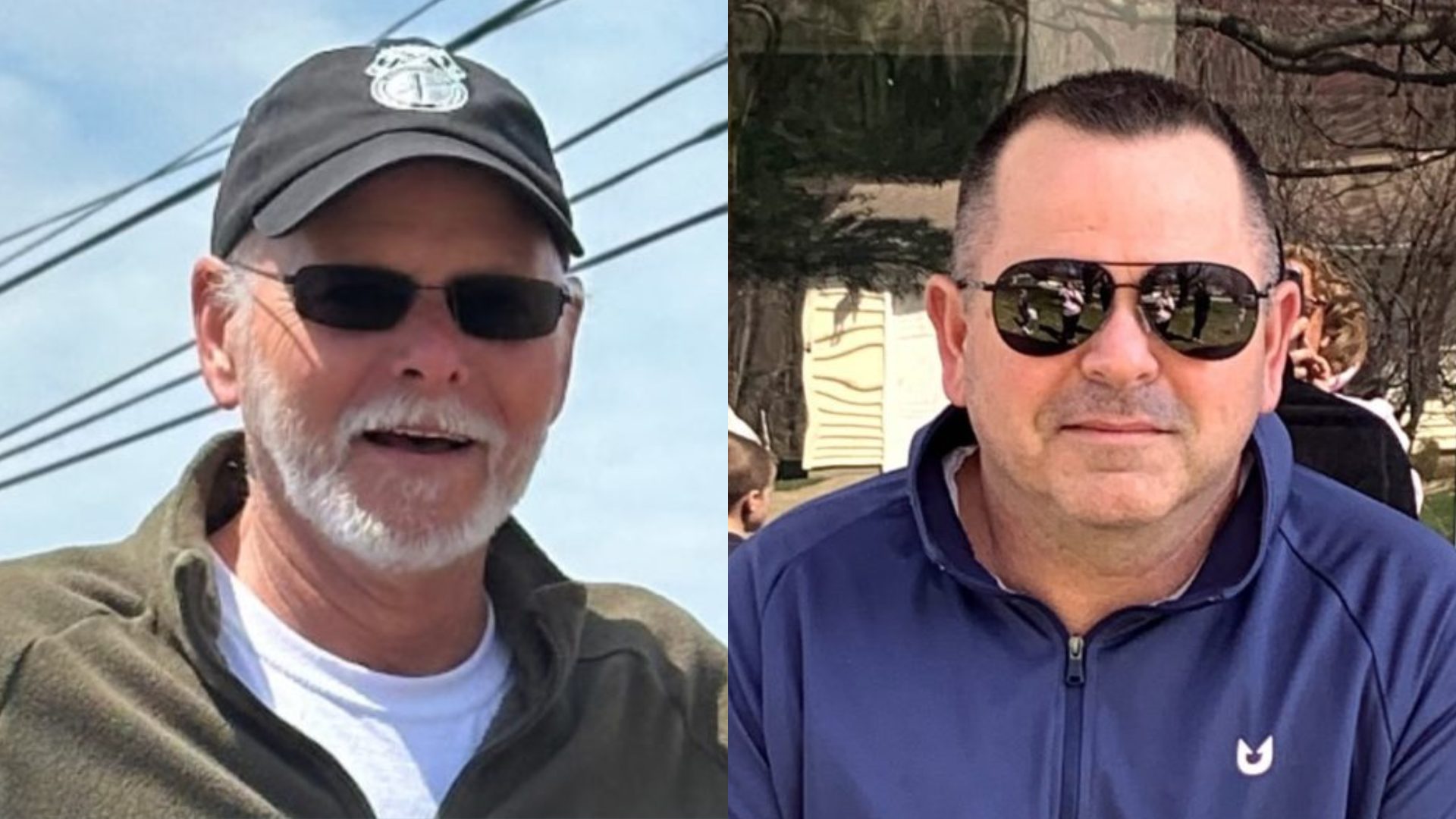
This week’s frontline faces: Glenn Painter and Jeff Stitt, employees with 50 years of combined experience at a chemical plant in the small Ohio town of Ashtabula. INEOS, a UK conglomerate led by the British billionaire Sir James Arthur Ratcliffe, took over the plant in 2019.
What they’re doing to help create a more equal world: Painter, Stitt, and their co-workers have been on strike since April 10. They walked out after the company demanded additional benefit cuts after years of squeezing workers by jacking up their health care costs, cutting pensions, and imposing 12-hour shifts.
What makes this fight so important: Standing up for decent working conditions means more to Painter and Stitt than their own economic security. At stake in their struggle: the health and safety of their entire community, Painter and Stitt explain in a new op-ed for Inequality.org.
During the strike, INEOS has hired relatively untrained replacement workers. Painter and Stitt say they’ve already seen the consequences.
“A recent leak created a thick chemical cloud that lingered over part of the facility,” they note. “There’s a daycare down the street from this plant. That day, the wind carried the cloud away from it. But if conditions had been different, that daycare — and the surrounding community — could have faced serious health risks.” For more, read Painter and Stitt’s op-ed at the link below. |
The Rich and the Pentagon Are Pricing Hawaiians Out of Paradise
Wealthy, out-of-state investors play a major role in pushing Hawaii real estate prices sky-high. And the U.S. military’s massive presence in the state is pumping up that pressure on prices, forcing many local residents to move elsewhere.
In Honolulu County alone, active-duty service members with housing subsidies occupy more than 10 percent of renter-occupied units. A recent Institute for Policy Studies analysis finds that this presence increased average monthly rents for non-military residents by $1,848 in 2024.
To help alleviate these inflationary impacts, our housing expert colleague Omar Ocampo points out, all military personnel should live on bases, in new densely built housing if necessary. Local officials should also introduce tenant protections like rent control and invest in affordable social housing. For more on Hawaii’s housing crisis, check out Ocampo’s analysis below. |
INEQUALITY BY THE NUMBERS |
PETULANT PLUTOCRAT OF THE WEEK |
Yo, Young Folks, Time To Start Appreciating Our Capitalist Wonders
This week’s dour deep pocket: Michael Dell, the CEO of Dell Technologies, the computer giant that last week won a $9.7 billion Pentagon contract. That deal sent Dell’s net personal wealth soaring to $245.9 billion, making him the sixth-wealthiest individual in the entire United States.
What has Dell sour: American young people who don’t “appreciate the power of capitalism.” Says Dell: "We have too many families that have no capital investment at all, and so they don’t have any need to worry about capitalism. That’s not a good thing, we believe, for our country long term.”
Dell’s prescription for a populace more appreciative of the capitalist way? This past December, Dell and his wife Susan joined with Donald Trump to announce a $6.25 billion gift that will underwrite the new “Trump Accounts,” a program that has children born in 2025 through 2028 eligible for a $1,000 deposit into investment accounts that can’t be accessed until they turn 18.
Those young may have to wait a bit to benefit from Dell’s $6.25 billion gift, but that gift is already paying dividends for Dell that go beyond his new Pentagon contract. Trump has been urging Americans to “go out and buy a Dell computer.” Dell’s company, Trump is trumpeting, makes “phenomenal products.”
The last word: Donald Trump himself appears to be making “phenomenal” profits from his personal investments in Dell. He’s invested millions of dollars in shares of Dell stock since January. Dell share values, over the past four months, have jumped more than 240 percent.
|
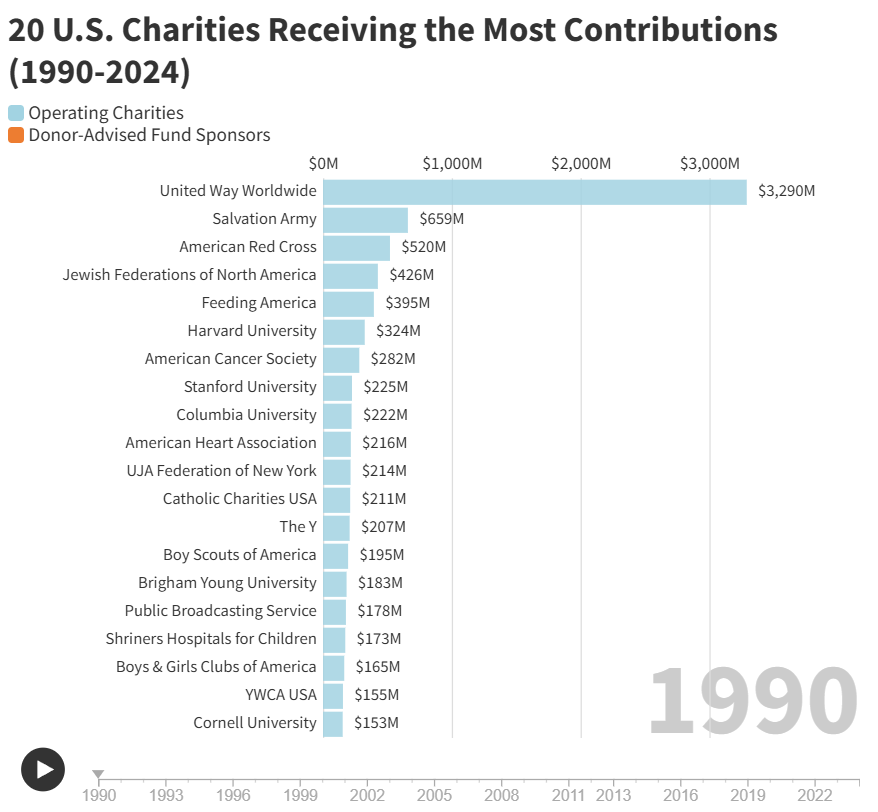
A new Institute for Policy Studies report examines the 20 public charities that have been receiving the most donations over recent years. Back in 1990, every organization in the top 20 directly carried out charitable work, as the chart above shows. But the landscape has come to look dramatically different in recent years.
Donor-advised funds — places where tax-deducted donations can sit unused for years — have come to have a huge presence. Click the Inequality.org link below to see how large that presence has become and why this new reality so matters. |
|
|
|
What's new on Inequality.org
Glenn Painter and Jeff Stitt, INEOS Teamsters and Chemical Workers Fight for a Fair Deal. Workers at an Ohio plant are striking after INEOS, one of the world’s largest chemical companies, has pushed sweeping cuts.
Dan Petegorsky, The Shameful Hypocrisy of Schwab’s Donor-Advised Fund Affiliate. By cutting off funding to the Southern Poverty Law Center, a public interest group targeted by the U.S. Department of Justiuce, commercial DAFs are making dangerous choices.
Elsewhere on the web
Emmanuel Saez and Gabriel Zucman, The Case for California’s Billionaire Wealth Tax, New York Times. The proposed tax going before state voters this November would be a one-time levy of 5 percent on billionaire wealth. The measure, if enacted, would be the world’s first tax on billionaire fortunes.
Should billionaires pay more taxes? WHYY. With America’s billionaire class growing, several states and members of Congress are proposing to tax wealth directly. Polls show most Americans, notes Inequality.org’s Chuck Collins, think the rich aren’t paying their fair share.
Brian Merchant, How Anthropic used AI ethics slop to play the pope and eclipse OpenAI, Blood in the Machine. How to ensure that everyone shares in the gains from AI, says the CEO of AI giant Anthropic, remains an “unsolved problem.” Really? Ever hear of progressive taxation?
Elizabeth Warren, Why We Need to Tax AI, Time. By overhauling the tax code, we can make sure that the winnings from AI benefit all Americans rather than just a wealthy few.
Jake Johnson, Sanders Sovereign Wealth Fund Plan Would Give US Public ‘Direct Ownership Stake’ in AI Giants, Common Dreams. A new bill from Bernie Sanders would guarantee that the trillions that AI figures to generate help improve the lives of everyone, not simply make our richest even richer.
Unequal Chances: Children and economic inequality, UNICEF. A new UN report finds that the wider a nation’s gap between rich and poor, the poorer children’s physical health and mental well-being.
Paul Krugman, The New Inequality, Substack. America’s economic rewards are increasingly going to shareholders as profits instead of to workers as earned income. Within the growing upwards distribution, to make matters worse, wealth is concentrating at the most elite top.
Robert Reich, It's Still Capital vs. Labor, Stupid, Substack. The U.S. worker share of the nation’s income has now dropped to its lowest level since records began in 1947. The profit share hasn’t been at its current high level since 1950.
Nick Hanauer and Eric Beinhocker, The Economic Experiment That Upended Reality, Atlantic. Attempts to make economies fairer, economic orthodoxy holds, end up making economies less efficient. But equity and efficiency, modern scholarship shows, actually go hand in hand.
Alex Welch, As Inequality Grows, More States Look to Tax the Rich, Institute on Taxation and Economic Policy. From Rhode Island to California, efforts to tax the rich are gaining serious political momentum.
Les Leopold, The Billionaires Have Two Parties: The Great Plains Has One, Wall Street’s War on Workers. Rebuilding progressive populism requires the boldness of the original prairie populists. Those activists led the way to a graduated income tax and serious anti-monopoly moves against the nation’s robber barons.
|
|
|
|
Monthly Donors Make This Read Possible! |
Inequality.org, an Institute for Policy Studies nonprofit project, depends on donations to keep this newsletter free and available to all readers. Your monthly gifts make all the difference in the world, whether you can donate $3 or $300 a month. {{if --[[Inequality Sustainer, 60 day gifts]] SavedSearch_523974}}Thank you for being a monthly donor. You can head to our self-service page at any time to see your giving history and make changes to your subscription.{{else}}Ready to give a few bucks a month? Sign up today.{{end}}
|
|
|
|
Inequality.org | www.inequality.org | inequality@ips-dc.org Institute for Policy Studies
1301 Connecticut Avenue Ste 600
Washington, DC 20036
United States
Managing Editor: Chris Mills Rodrigo
Co-Editors: Sarah Anderson, Chuck Collins, Bella DeVaan, Reyanna James, and Sam Pizzigati |
|
|
|
|