A weekly newsletter from the Institute for Policy Studies
|
|
|
Iran war profiteering, inequality fighters prevail in New York’s primaries, and tackling DC’s racial wealth gap
|
|
|
|
As I write this, U.S. and Iranian negotiators are struggling to hammer out a lasting peace agreement. But deal or no deal, the damage to the world economy has already been done.
Per usual, ordinary people are paying the highest price. The conservative American Enterprise Institute estimates that the four-month conflict has so far cost the average U.S. household as much as $1,313.
In the Global South, the war’s economic fallout is running far worse. Higher food and energy costs, the UN warns, have some 33 million people now at risk of falling into poverty before this year ends.
Meanwhile, Wall Street banks, arms manufacturers, and Big Oil have reaped huge profits off war-related market volatility and militarization. And members of Congress next week could push opportunities for profiteering to even higher heights as they take up Trump’s request for a $1.5 trillion Pentagon budget.
Trump should instead be using his position as this year’s G20 president to coordinate efforts to lessen the pain of the crisis. Reyanna James and I have just made this case in an Oxfam commentary. We also invite you to subscribe to G20 Watch, a new Institute for Policy Studies monthly on efforts to push this club of our world’s largest economies to focus more on combating global inequality.
Sarah Anderson
for the Institute for Policy Studies Inequality.org team
|
|
|
|
INEQUALITY BY THE NUMBERS
|
A New Generation of Inequality Fighters on Its Way to D.C.
A political earthquake hit New York City Tuesday evening as three self-described democratic socialists won their respective Democratic primaries, all but ensuring they’ll be representing the city in Congress next year.
Union organizer Claire Valdez defeated Brooklyn borough president Antonio Reynoso, former city comptroller Brad Lander unseated Dan Goldman, and doctoral student and Palestine-solidarity organizer Darializa Avila Chevalier toppled the Democratic machine behind incumbent Adriano Espaillat.
All three progressives had the active backing of mayor Zohran Mamdani, who last year shocked the Democratic establishment himself by defeating Andrew Cuomo.
New York’s new congressional contingent will have to wait until after November to stamp their tickets to Washington, but, once sworn in, the three will join a burgeoning progressive wing of the Democratic party advocating for core Inequality.org's policies ranging from taxing the rich to facilitating labor organizing.
New York’s left success — led by the city’s Democratic Socialists of America chapter — went beyond the headline congressional races. DSA-endorsed candidates won at all city and state government levels, adding to a national winning streak for left leaders like Chris Rabb in Pennsylvania and Janeese Lewis George in D.C. The question now: How will this reinforced left operate in office?
|
A Wealth Tax to Fight Racial Inequality in the Nation’s Capital City
D.C.’s City Council will be confirming the city budget for next year without a key way to generate revenue — taxing wealth — even on the table.
But advocates for greater economic equality in the nation’s capital are pushing hard for a surcharge on the annual growth in the wealth holdings of the rich, arguing that a 3 percent tax on those wealth proceeds could generate $161 million in revenue to offset federal cuts to critical social services.
A wealth tax, Kennith RaShaun Woods II writes in his Inequality.org debut, could also kick off a long march to addressing D.C.’s deep racial wealth divide. New revenue streams, especially after years of austere budgets from outgoing mayor Muriel Bowser, could be transformative for the city. To read more about the fight for a wealth proceeds tax in D.C., click the link below.
|
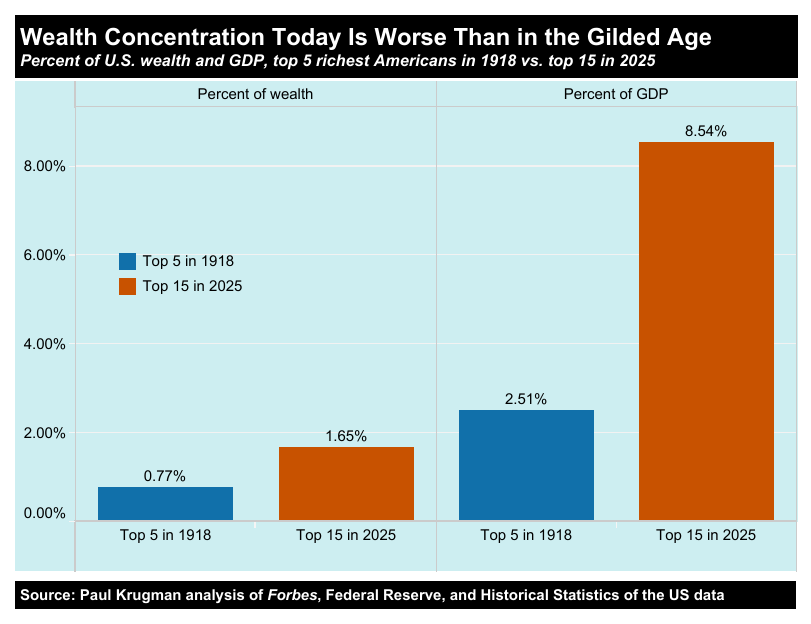
Many people have compared our current era to the Gilded Age, but that comparison may understate the scale of modern inequality.
Today’s oligarchs are even wealthier, relative to the size of the economy, than the robber barons of a century ago. A new analysis by economist Paul Krugman compares the wealth of the five richest Americans in 1918 with the wealth of the 15 richest Americans in 2025 — a larger group because the U.S. population has more than tripled since 1918.
Krugman’s striking findings: Today’s highest fortunes equal 1.65 percent of all U.S. wealth and 8.54 percent of GDP, compared with 0.77 percent of wealth and 2.51 percent of GDP for the richest Americans in 1918.
For an interactive version of this chart and more on wealth inequality, click the link to our Inequality.org Facts section below.
|
PETULANT PLUTOCRAT OF THE WEEK
|
Let’s Help a Coal Know-Nothing Make a Fortune Off Coal
This week’s dour deep pocket: Alex Phillips, a top partner at TerraSpark, a virtually unknown start-up that Team Trump tapped earlier this month to start planning a billion-dollar-plus, state-of-the-art coal-fired power plant. Power from the plant will juice a yet-to-be-built West Virginia data center.
What has Phillips sour: any hint that he may not be qualified for the task.
But critics, Politico details, aren’t just hinting. They’re charging that Phillips has zilch experience in anything related to either coal or power generation. That lack of experience, says his partner Bill Tolpegin, actually counts as a “good thing” because “conventional” thinking has blinded coal execs.
A more likely reason why Phillips has won this new Trump coal nod: his “long history” backing assorted Trump fantasies. The Phillips-run American Priority Conference, widely known as AMPfest in right-wing circles, gave an early platform to MAGA’s QAnon-adjacent wing and Trump fanboys like Roger Stone and Mike Flynn. Phillips has also championed Trumpian election deniers.
The last word: The new TerraSpark contract represents only a piece of the Trump coal agenda. Observes the Natural Resources Defense Council’s Kit Kennedy: “Propping up coal billionaires with taxpayer money is one more way for the Trump administration to put polluters first and put the rest of us at risk. What’s next, a taxpayer bailout to build new phone booths?”
|
|
|
|
New on Inequality.org
Helen Flannery, DAF-to-DAF Giving Reached $7 Billion in 2024. Over the past five years, donor-advised fund sponsors have granted more than $23 billion to other donor-advised fund sponsors.
Elsewhere on the web
Reyanna James and Sarah Anderson, The G20 Protected Financial Markets in 2008. This Time It Must Protect People, Equals. The G20’s response to the 2008 crash showed coordinated action is possible — but also revealed the dangers of recovery plans that protect markets over people.
Billionaire Wealth Surges Past $9 Trillion for First Time, Americans for Tax Fairness. Thanks in no small part to the Trump 2025 tax cut for America’s richest, U.S. billionaire wealth has jumped 32 percent over last year. Our richest 16 now hold 43 percent of all U.S. billionaire wealth.
Eduardo Porter, Condemned to plutocracy? The relentless rise of US inequality, The Guardian. Does the United States have any appetite for redistribution? With AI displacing human labor and rewarding the owners of capital, the share of the nation’s income that accrues to workers will only likely shrink.
David Lingelbach and Valentina Rodríguez Guerra, How to Contain the Oligarchs, Washington Monthly. From ancient Greece to New Deal America to today’s Hungary, democracies have found ways to separate private fortunes from public power.
Gabriel Zucman, The era of trillionaires will be dire for democracy, Substack. How we can fight back: some advice from the most impactful inequality scholar in our world today.
Dean Baker, Wealth and the Political Power of Billionaires, CounterPunch. The rich have far too much political power, but we will have to go far beyond a wealth tax to correct this problem — by, for instance, restructuring the economy that makes the super rich so rich in the first place.
Erin Deborah Waks, How much does it really cost to own a private jet? Daily Express. The millions only really start flowing after purchase time. Fuel alone runs between $500,000 and $2 million a year.
Greenpeace accuses the world’s richest 0.01% of having nearly $1 billion in climate debt, PlusNews. In 2022, the most recent year with full stats available, the investments of the world’s wealthiest 0.01 percent generated an estimated $992 billion in climate damage.
Catherina Gioino, Executive pay climbed again in 2025 — and the CEO-to-worker gap kept widening, Fortune. Exclude Musk’s ridiculous $158.4 billion Tesla stock award and median CEO total compensation still rose 13 percent last year.
|
|
|
|
Monthly Donors Make This Read Possible!
|
Inequality.org, an Institute for Policy Studies nonprofit project, depends on donations to keep this newsletter free and available to all readers. Your monthly gifts make all the difference in the world, whether you can donate $3 or $300 a month. Ready to give a few bucks a month? Sign up today.
|
|
|
|
Inequality.org | www.inequality.org | inequality@ips-dc.org
Institute for Policy Studies
1301 Connecticut Avenue Ste 600
Washington, DC 20036
United States
Managing Editor: Chris Mills Rodrigo
Co-Editors: Sarah Anderson, Chuck Collins, Bella DeVaan, Reyanna James, and Sam Pizzigati
|
|
|
|
|