January 8, 2025                                                         Home   Subscribe  Open in Browser


A weekly newsletter from the Institute for Policy Studies


THIS WEEK

Last year turned out to be a huge year for billionaires. America’s nine-figure club didn’t just collectively gain over $1 trillion in wealth in 2024. They also installed a president committed to expanding their already domineering political presence.

Yes, the situation certainly does look dire for those of us fighting for a more equal society. But we've been here before — and ended up winning. Back in the late 19th century, an unchecked industrialization brought a massive concentration of our nation’s wealth. Corporate titans saw their influence in culture and politics soar, putting them in a position much like the position our wealthiest enjoy today.

But then, as our co-editor Sam Pizzigati chronicles in his book The Rich Don't Always Win, average Americans organized and won the country back through mass movements that inspired broad policy reforms. Our task now: to take inspiration from that success and put an end to our second gilded age.

One additional note: Thank you so much to everyone who donated in our Inequality.org end-of-the-year fundraising drive. Your support remains ever so essential to our work.

Chris Mills Rodrigo
for the Institute for Policy Studies’ Inequality.org team


INEQUALITY BY THE NUMBERS

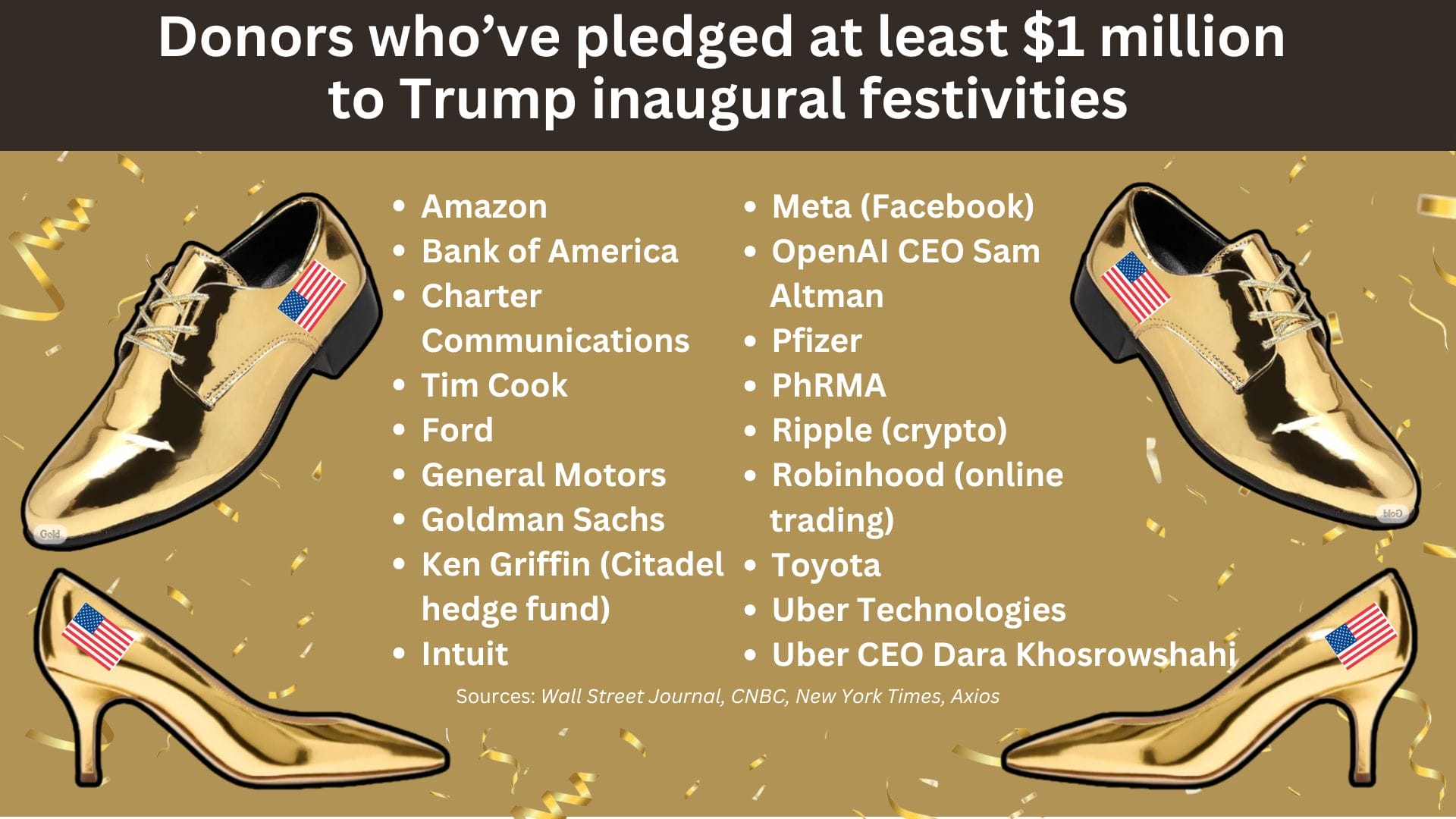
A list of donors who've pledged at least $1 million to Trump inaugural festivities: Amazon, Bank of America, Charter Communications, Ford, General Motors, Goldman Sachs, Ken Griffin, Intuit, Meta, Sam Altman, Pfizer, PhRMA, Ripple, Robinhood, Toyota, Uber, Dara Khosrowshahi. Sources: Wall Street Journal, CNBC
 

FACES ON THE FRONTLINES

Lina Khan and Jonathan Kanter

An Antitrust Revolution Cut Short: Two Giants Leave Their Mark

This week’s frontline faces: Lina Khan and Jonathan Kanter, the outgoing leaders of the Federal Trade Commission and U.S. Justice Department antitrust division.

What they've done to help create a more equal world: Khan and Kanter revitalized our long complacent antitrust agencies into organizations focused on breaking corporate consolidation and giving Americans true freedom of choice.

The highlights of Khan's term include cracking down on junk fees, blocking Kroger’s proposed acquisition of Albertsons, and advancing high profile lawsuits against Big Tech firms. Kanter, for his part, led Justice Department efforts to break up Live Nation-Ticketmaster, challenge a de facto American Airlines-JetBlue merger move, and sue Google for its monopolization of online searching.

What makes equality so important to them: Corporate exploitation of market power, as Kanter noted in his December farewell address, has “become more threatening to our democratic institutions than ever before and at a level we had not experienced since the Gilded Age."


BOLD SOLUTIONS

Let’s End Some Obscure — and Lucrative — Billionaire Loopholes

Senator Ron Wyden’s proposed Billionaires Income Tax bill would, if enacted, close two favorite loopholes of America’s ultra-wealthy. The first of these loopholes, the “buy-borrow-die" trick, makes untaxed gains on assets essentially disappear, for tax purposes, when individuals pass away, a process that eases the way for the accumulation of dynastic fortunes.

Institute for Policy Studies associate fellow Bob Lord has dubbed the second and less common trick the “Buy-Hold for Decades-Sell” maneuver. This loophole recognizes that the effective annual tax rate on asset growth declines as the length of the holding period on assets increases. This loophole let the ultra-wealthy pay well below expected tax rates. Check Bob Lord’s take on just how.

BILLIONAIRES INCOME TAX
 

CHART OF THE WEEK

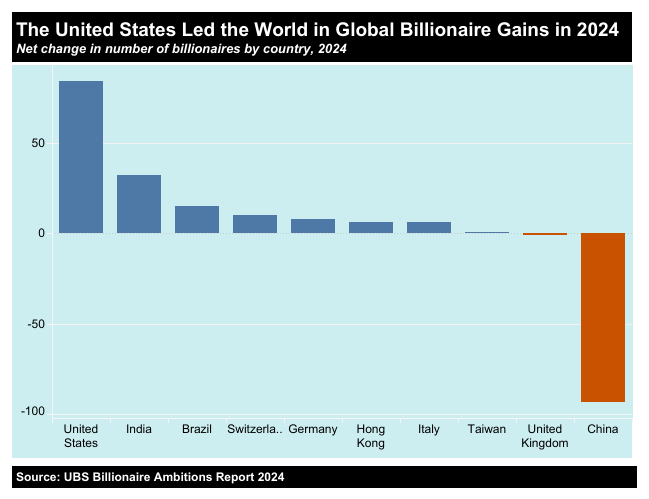
A chart showing the change in billionaires by country.

Compared to other countries, the United States saw the largest expansion of its billionaire class in 2024, according to UBS. By the Switzerland-based investment bank’s count, the number of American billionaires rose from 751 in 2023 to 835 in 2024. By contrast, China’s nine-digit club shrunk from 520 to 427 as a real estate crisis and financial market turmoil pushed many newly minted billionaires below the $1 billion mark. For an interactive version of this chart and more on global inequality, click the link to our Inequality.org Facts section below.

DIVE DEEPER
 

TOO MUCH

What Would Surprise Our Rich in 2025? Not Getting Richer.

Our new year has begun with old news: The world is continuing to become colossally more unequal — with the United States leading the way. The world’s 500 richest began 2025 worth just under a combined $10 trillion. Over a third of the $1.5 trillion in new wealth that they gained in 2024 came in the five weeks after Donald Trump’s election.

In 2025, households in America’s top 0.1 percent will be pocketing an average savings of $252,300 from Trump’s 2017 tax cut. Most of that giant tax cut — for the rich — will expire at the end of this year. Can the GOP Congress stop that expiration? Inequality.org co-editor Sam Pizzigati has more. 

TAX SHOWDOWN
 

PETULANT PLUTOCRAT OF THE WEEK

Steven Witkoff

Who’s Going to Shout ‘Fore’ in This Year’s Mideast Peace Talks?

This week’s dour deep pocket: Steven Witkoff, the billionaire Manhattan real estate investor just named as president-elect Donald Trump’s special envoy to the Middle East.

What has Witkoff sour: any suggestion that this long-time Donald Trump golfing buddy lacks the necessary diplomatic experience to help broker a lasting Mideast peace.

Witkoff, an Axios profile notes, does have no experience in Mideast politics. But Witkoff has relied heavily on Middle East-based investment firm giants from Abu Dhabi and Qatar for a just-in-time bailout purchase of his troubled Park Lane Hotel in New York.

The last word: The first Trump administration, notes U.S. senator Ron Wyden from Oregon, gave his most loyal financial advisers “a chance to get rich off Middle East oil money.” With this history, adds Widen, giving appointees like Witkoff “the benefit of the doubt that they’ll represent American interests ahead of their own” rates as “awfully hard.”


GREED AT A GLANCE

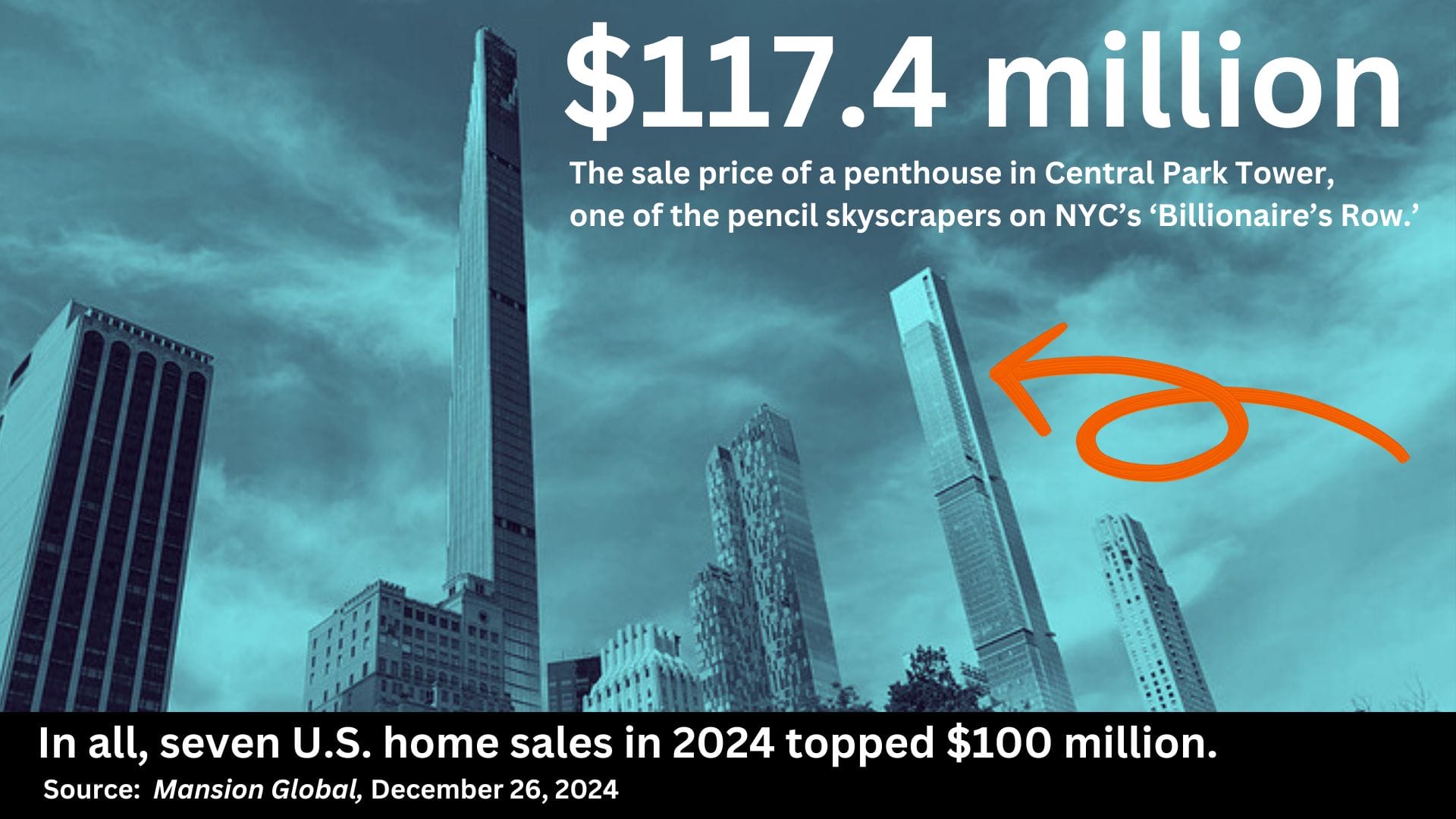
A photo of a New York skyscraper with the text: $117.4 million. The sale price of a penthouse in Central Park Tower, one of the pencil skyscrapers on NYC's 'Billionaire's Row.' In all, seven U.S. home sales in 2024 topped $100 million. Source: Mansion Global, December 26, 2024
 

MUST READS

What's new on Inequality.org


Sarah Anderson and Chris Mills Rodrigo, 10 Inequality Victories in 2024.
Our year-end review of 10 of the most inspiring inequality wins, from union drives to fair taxes to consumer protection.


Helen Flannery and Bella DeVaan, The Sisyphean Task of Giving Tuesday. The national day of donations brought in $3.6 billion this year — we need to make sure that money is actually going to charitable causes.


Mark your calendars


Tonight, January 8, at 7pm EST, join our own Chuck Collins in a panel discussion on private jets and "sustainable" aviation fuels. To register, click here.


Elsewhere on the web


Iker Seisdedos, Elon Musk, unelected president and agent of chaos, El País. All Musk’s companies, notes Inequality.org’s Chuck Collins, have undergone traumatic restructurings at the expense of their workers.


Rasheeda Childress, 5 Trends That Will Shape Fundraising in 2025, The Chronicle of Philanthropy. A look at how the landscape for fundraisers will change over the next year.


Ingrid Robeyns, People With Extreme Wealth Should Give It Away — or Be Penalized, Wired. In 2025, the fight against rising wealth inequality will be high on the global political agenda. The Belgian-Dutch philosopher Robeyns explains why.


Bernie Sanders, Two Americas, the people vs. the billionaires, Fox News. Over 60 percent of Americans now live paycheck to paycheck. Meanwhile, our three richest hold more wealth than the nation’s bottom half, over 165 million people.


Rachel Greenley, Packed Cubicles, Empty Corner Office: Remote Work Is Increasingly a Right of the Rich, New York Times. Starbucks now has a private jet that takes its chief exec to his Seattle corporate office from his home — in Southern California.


Damian Carrington, ‘We need dramatic social and technological changes’: is societal collapse inevitable? Guardian. Studies of failed civilizations consistently show that deep inequality and social disaster go hand in hand.


Lynn Parramore, America’s Health Insurance Grinches: A Scathing Indictment of “Market” Economics, Institute for New Economic Thinking. The deeply flawed U.S. insurance model, driven by greed, leads to inefficiency, inequality, and denied care — a colossal scam that has sparked fury across the nation.


Robert Reich, The 20 realities of the American system (before Trump gets a second crack at wrecking it even more), Substack. Forget politics as battles between Democrats and Republicans. Our underlying contest sets an oligarchy of extraordinarily wealthy against a vast majority with little wealth at all.


Timothy Noah, We’re Already Seeing Signs That Trump Is Tanking the Economy, The New Republic. Donald Trump’s election provides a useful occasion to examine the difference between what rich people want and what constitutes a thriving economy.


William Gale, Oliver Hall, and John Sabelhaus, How should we tax the Great Wealth Transfer? Brookings. Taxing inheritances and unrealized capital gains at death would close two of the largest loopholes in the U.S. tax code.


Danny Sriskandarajah, The rest is not just politics: how inequality is trumping democracy, LSE. The exponential accumulation of wealth and power by the “private few” is reducing the capacity of the “public many” to exercise the freedom to make the choices that shape our lives.


Sasha Abramsky, My 2025 Project: Starting a New Column, The Nation. Elon Musk, with Trump’s full blessing, is treating America as he treated Twitter. He’s regarding it as his personal prize, as conquered corporate territory, its assets to be disposed of how he sees fit.

 

HOW WE MAKE THIS WORK

Our research, editorial, and publishing team depends on hundreds of paid subscribers who make monthly gifts. Some give $3 each month; others give $200! All told, this support enables our team to stay focused on identifying causes and solutions to our deep economic inequality. Paid subscribers have contributed more than $20,000 in the past year. Ready to become a paid subscriber? Sign up today.


Inequality.org | www.inequality.org | inequality@ips-dc.org

Institute for Policy Studies
1301 Connecticut Avenue Ste 600
Washington, DC 20036
United States 

Managing Editor: Chris Mills Rodrigo
Co-Editors: Sarah Anderson, Chuck Collins, Bella DeVaan, and Sam Pizzigati

FacebookTwitterCustom