A weekly newsletter from the Institute for Policy Studies |
|
|
Some 159 years ago today, months after the Civil War ended, enslaved people in Galveston, Texas finally learned they had been “freed.” Our Juneteenth holiday celebrates that end of slavery, but anyone with a basic grasp of American history knows that Black people hardly gained their freedom in 1865.
A look at wealth inequality today makes it plain to see that Black Americans still suffer from slavery's legacy. For every $100 white households held in 2022, Black households held just $15. Black Americans today face obstacles to accumulating wealth at every turn, from exclusionary housing practices to racist hiring regimes.
How do we redress this historic injustice? In this week’s issue, we're offering a look at a few specific targeted policy interventions that could make a real difference. But, in fact, any of the solutions to runaway wealth concentration that we bandy about on Inequality.org would represent a step in the right direction — so long as we always keep racial imbalances in mind. Chris Mills Rodrigo
for the Institute for Policy Studies’ Inequality.org team |
|
|
INEQUALITY BY THE NUMBERS |
|
|
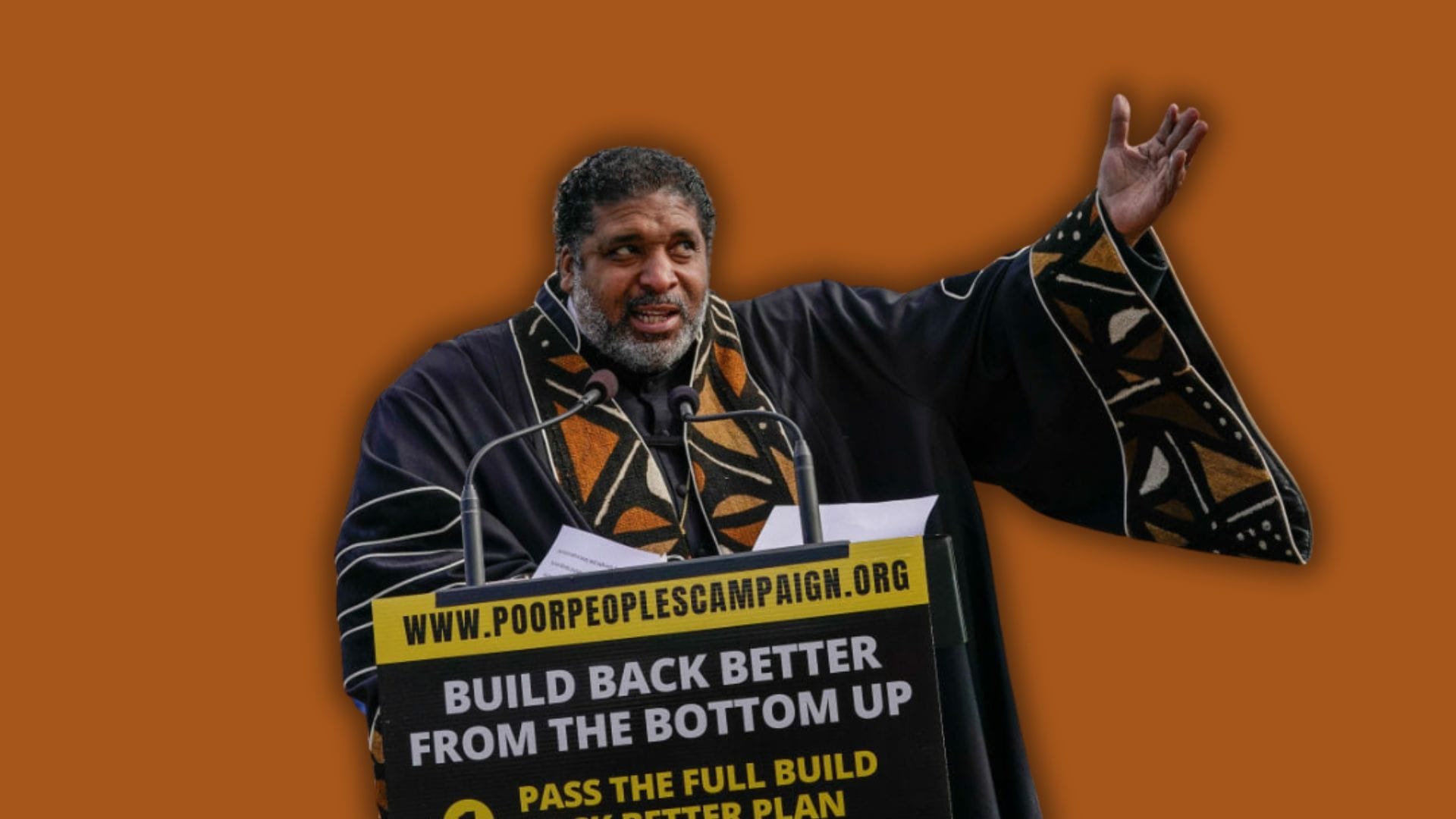
Finally Bringing America's Poor Into the Political Mainstream This week’s front-line face: Rev. William Barber II, a minister and social activist. What he’s doing to help create a more equal world: Barber co-chairs the Poor People's Campaign, a national organization working to mobilize millions of poor and low-income Americans and make their voices heard in the political process.
In that work, the Poor People’s Campaign is helping make sure that our ongoing electoral discussions and debates seriously address issues that range from income inequality and systemic racism to ecological devastation.
What makes this fight so important to him: Political campaigns, Rev. Barber noted earlier this year, do not typically talk to poor people's issues.
“In our election cycles we sometimes have 15 or 20 debates for president," he notes. "In 2020, not one of those debates — not 15 minutes — went to raising questions about how the policies of a particular party or politician would impact poor and low-income people.”
For more information on the upcoming Poor People's Campaign march in Washington, D.C. later this month, click below. |
|
|
To Correct Wealth Imbalances, We Need To Start at Birth
The racial wealth gap has haunted Black Americans ever since emancipation, thanks to generations of racially discriminatory policies. A new program in Connecticut could help change that wealth gap reality.
Connecticut recently implemented an innovative “Baby Bonds” program that will be investing $3,200 for every child in the state born into poverty. Once these children reach an age between 18 and 30, they can cash out their bonds and most likely have a nest-egg somewhere between $10,000 and $24,000 in value. Baby Bond recipients can use that money to help pursue their education or job training, start a business, or even buy a home.
Economists William Darity and Darrick Hamilton proposed the notion of Baby Bonds back in 2010. By implementing Baby Bonds programs at the state-level across the nation, Dedrick Asante-Muhammad contends, our nation could make real progress toward closing the racial wealth gap and giving all poor people in the United States a pathway out of poverty.
Read more below on Baby Bonds from Asante-Muhammad, an Institute for Policy Studies associate fellow and the current president of the Joint Center for Political and Economic Studies. |
|
|
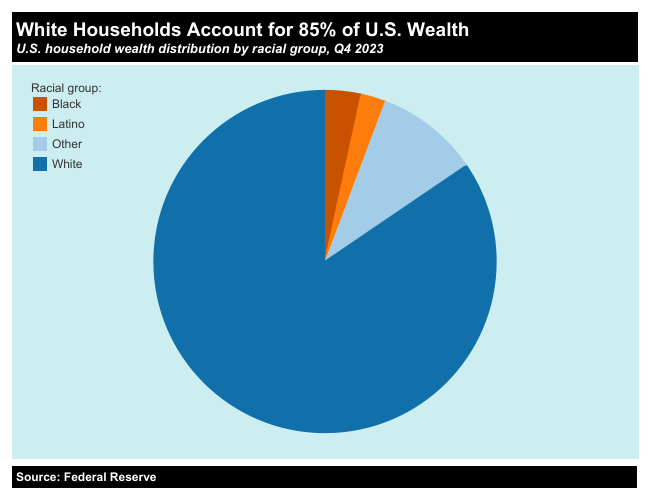
Public policies that favor white Americans — particularly very wealthy white Americans — have perpetuated an extreme racial wealth divide in the United States. According to the Federal Reserve, white households held 84.5 percent of all U.S. wealth at the end of 2023. By contrast, Black households held just 3.4 percent and Latinos only 2.3 percent of national wealth. For an interactive version of this chart and more on wealth and inequality, check out the link below.
|
|
|
U.S. CEOs: Bequeathing Us a Frightfully Unequal Future
In the decade ahead, a new report forecasts, over a quarter of our global wealthy worth at least $5 million will be passing on “almost $31 trillion” to their nearest and dearest. Some 64 percent of that total will be coming from the “ultra wealthy,” deep pockets worth over $30 million. Corporate execs will make up over 71 percent of these ultras, entrepreneurs another 21 percent. And nearly half these ultra execs and entrepreneurs will be Americans.
In other words, the billions America’s top execs have amassed since the early 1980s will be vastly expanding the ranks of those who hold massive amounts of inherited wealth. Inequality.org co-editor Sam Pizzigati has more. |
PETULANT PLUTOCRAT OF THE WEEK |
A Corporate Chief Executive Who’s Learned How To Plow for Profits
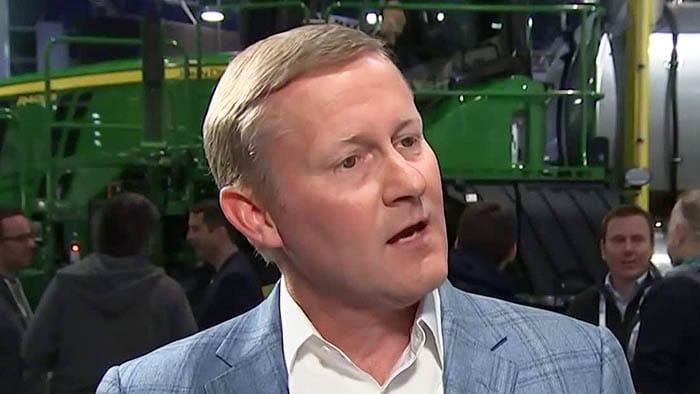
This week’s dour deep pocket: John May, the CEO of Deere & Co., an Illinois-based global giant known primarily as a manufacturer of farm machinery and other heavy equipment.
What has May sour: the bad press greeting John Deere’s recent and ongoing layoff announcements at several of the company’s U.S. plants. The company is citing “economic reality” as the driver for the job cutbacks, now totaling about 1,000 in Iowa and Illinois alone.
That same “economic reality” has brought plenty of good news for Deere’s executive set and top shareholders. The company has reported $10 billion in fiscal 2023 profits.
The company has also spent more than $12 billion on stock buybacks over the last two years, a move designed to nudge up the company’s share price. Moves like that have helped CEO May to $26.7 million in fiscal 2023 compensation, up from a mere $20.3 million the year before.
The last word: John Deere, notes labor journalist Les Leopold, “should be renamed ‘Greed R Us.’” |
|
|
What's new on Inequality.org
Rob J. Gruijters, Nicole Kapelle, Zachary Van Winkle, and Anette Fasang, Millennials’ Wealth Is Finally Growing — But So Is Inequality. The relatively decent financial state of Millennials as a whole is hiding the reality of a wildly wealthy and a struggling majority.
Elsewhere on the Web
Robert Reich, America’s problem is massive inequality – not ‘woke’ educated elites, Guardian. Fake populists like Elise Stefanik (Harvard ’06) and Josh Hawley (Yale ’06) attack higher ed to protect corporations and the rich.
Jessica Corbett, Sanders, Omar Lead Call for Biden to Back Global Tax on the Rich, Common Dreams. Brazil is calling on the G20 nations to push taxing the world’s richest. Biden’s 2025 budget blueprint calls for a 25-percent minimum tax on Americans with wealth over $100 million.
J. Bradford DeLong, To Understand Elon Musk’s Descent, Look at His $46 Billion Pay Package, New York Times. In 2018, Tesla dreamed up an unorthodox pay package that, in theory, tied Musk’s pay to the company’s performance. The performance Tesla measured? Pushing Tesla’s stock price up.
Spencer Woodman, How the IRS went soft on billionaires and corporate tax cheats, International Consortium of Investigative Journalists. The IRS division that audits the ultra rich and the corporations they run has flagged only 22 possible tax crimes over the past five years, roughly 40 times fewer criminal referrals than from the IRS unit that covers small businesses.
Anne Kim, The Rise of Poverty Inc., The Atlantic. In the 1980s, the federal government began aggressively privatizing government functions. One result: a lucrative set of industries fueled by federal anti-poverty programs that often take advantage of the people they ostensibly serve.
Katharina Pistor, American business will regret writing off democracy, Social Europe. The business world has never shown a real penchant for democratic governance, notes the author of The Code of Capital: How the Law Creates Wealth and Inequality.
Karrie Jacobs, Elevators and Escalades: The rise of New York’s super-tall luxury buildings, Nation. in a sane world, billionaires and their corporations would pay enough in taxes to directly fund low-cost public housing. Robert Burgess, The Billionaires Backing Trump Have Selective Memory, Bloomberg. America’s richest now see a real shot at extending the former president’s handouts to the wealthy and watering down regulations.
Paul Krugman, Freedom’s Just Another Word for Not Paying Taxes, New York Times. Trump allies in Congress have committed themselves not just to tax cuts but to starving the IRS of resources, a move that would help more wealthy Americans evade the taxes they legally owe. Juliana Kaplan, Welcome to the age of geriatric millionaires, Business Insider. An increasing share of America’s wealth is concentrating in the hands of America's octogenarians. |
|
|
Our research, editorial, and publishing team depends on hundreds of paid subscribers who make monthly gifts. Some give $3 each month; others give $200! All told, this support enables our team to stay focused on identifying causes and solutions to our deep economic inequality. Paid subscribers have contributed more than $20,000 in the past year. Ready to become a paid subscriber? Sign up today. |
|
|
Inequality.org | www.inequality.org | inequality@ips-dc.org Institute for Policy Studies
1301 Connecticut Avenue Ste 600
Washington, DC 20036
United States
Managing Editor: Chris Mills Rodrigo
Co-Editors: Sarah Anderson, Chuck Collins, Bella DeVaan, and Sam Pizzigati Production: Chris Mills Rodrigo and Georgia Jensen |
|
|
|