A weekly newsletter from the Institute for Policy Studies |
|
|
If talk of a government shutdown makes you feel like it’s Groundhog Day, you’re not alone. This Friday will mark the first in a new pair of deadlines for federal appropriations bills. Absent a deal, crucial agencies and programs will begin to go dark. What would even a partial shutdown mean for the average American?
The federal departments of Veterans Affairs, Transportation, Agriculture, and Housing and Urban Development, for starters, would all run out of funding. Shutting down these departments would shutter veteran outreach offices and bring travel delays, discontinue crucial food support programs and leave families missing housing loans. And any shutdowns, of course, would leave massive numbers of federal workers and their families without paychecks. None of this pain has to be — and wouldn’t be if we taxed our rich at meaningful rates. And if we did that taxing, we could as a nation start meeting all our public needs, including, as we note below, the need for a vibrant public media presence. Chuck Collins and Chris Mills Rodrigo
for the Institute for Policy Studies’ Inequality.org team |
|
|
INEQUALITY BY THE NUMBERS |
|
|
What We Can Do to Lessen the Financial Burden of Having a Child
Lindsay Saunders didn’t know just how difficult starting a family in the United States today can be until she had a child in 2021. Saunders found herself with no option but to take an unpaid maternity leave. Ever since, stress and trauma have marred her first experience with motherhood. She’s still struggling to cover exorbitantly expensive childcare.
“Again and again,” Saunders notes, “I had to choose between my health and a paycheck, which can feel like a punishment.” Now Saunders is advocating for the government to take its responsibility to families seriously. What would taking that responsibility look like? Paid parental leave and subsidized child care, Saunders points out, would create strong foundations for kids and their families.
In the shorter term, Saunders adds, allocating more funding to federal programs like the Women, Infants, and Children effort, WIC, and expanding the Child Tax Credit would help keep starting a family from becoming a financial catastrophe. |
|
|
Billionaires Won't Save Our Media. It's Time for Public Funding.
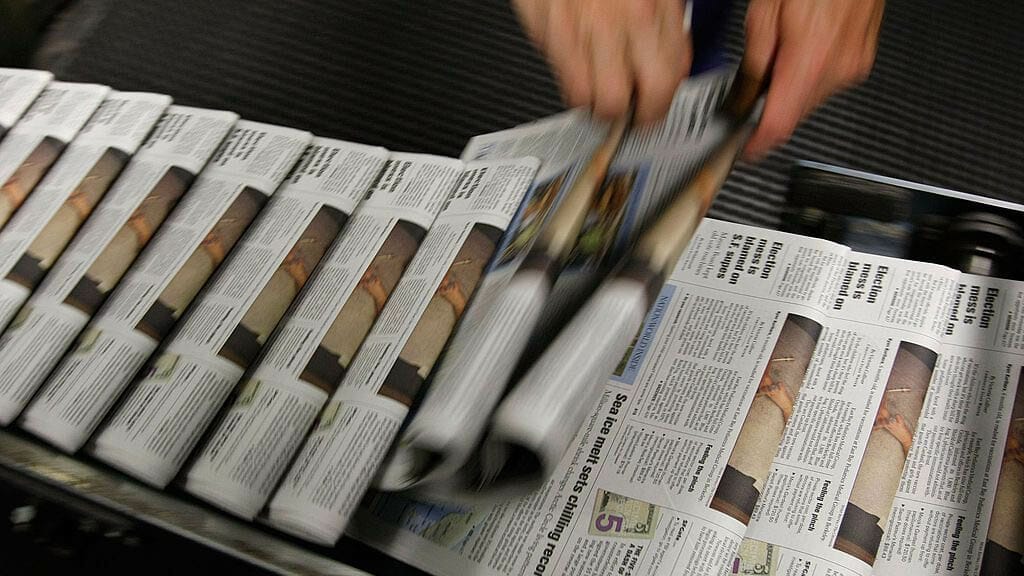
Several major U.S. media outlets have laid off staff or folded in just this year’s first two months. Billionaires have been investing heavily in media over recent years, but the ongoing loss of ad revenue has many of them cutting their losses, and the power over our media that the sector’s remaining rich owners exercise remains a troubling threat to our democracy.
Journalism in our modern era has turned out not to be particularly good at making money. Might it be time to stop asking journalism to be a money-maker? Enter the notion of publicly funded media, an alternative to sustaining news outlets across the country that wouldn’t rely on the whims of the market.
Our federal government currently contributes a paltry sum to public media — primarily PBS and NPR — relative to comparable countries. Bringing up our investments in public media to match the rest of the world would go a long way to reversing the worrying decline of media outlets all across the United States. |
|
|
Do High Taxes on Our Rich Make Any Sense? The Stats Say Yes.
Jurisdictions that tax the rich, the standard conservative mantra goes, will always end up watching those rich flee to areas that “sensibly” refuse to “soak the rich.” But right-wing harrumphing about the foolishness of raising taxes on our deepest pockets, note analysts who study tax data, rests on a relative handful of high-profile anecdotes that profoundly distort the actual tax-the-rich story. But even those jurisdictions that now tax the rich at our nation’s highest rates leave our wealthiest, after taxes, still fabulously wealthy. We need to do more than tax high incomes. We need to limit them. Inequality.org co-editor Sam Pizzigati has more.
|
PETULANT PLUTOCRAT OF THE WEEK |
An Oil Fortune Greases the Way for an Offensive Against Satan
This week’s dour deep pocket: Tim Dunn, a 68-year-old Texas oil billionaire who has, notes the Texas Monthly in a just-published analysis, spent the last two decades “quietly, methodically, and patiently building a political machine” that has pushed his state “forcefully to the right.”
What has him sour: conservative Republicans who have shown themselves to be “insufficiently loyal” to Dunn’s theocratic right-wing agenda. Dunn sees America’s most righteous “in the midst of a holy battle that pits Christians” against those who “want to control all property and take away freedom.”
Dunn has become his state’s “largest individual source” of campaign cash “by far” and has bankrolled, the Texas Tribune reports, “a sprawling network” of political action committees and media websites. He’s also started spreading his political pop around the national scene.
Since 2020, the Texas Observer points out, Dunn has been a managing director of Pipeline Media, part of an under-the-radar effort that manages “thousands of local news sites across the country.” None of these sites disclose their funding from “right-wing dark-money groups,” and the “news” they present promotes everything from opposing renewable energy to cutting funding for public schools.
The last word: Watching billionaires “take over our state and turn it into an authoritarian theocracy is terrifying,” reflects James Talarico, a Texas state lawmaker and a former public school teacher now studying to become a pastor. “Without this ecosystem built by Tim Dunn, we wouldn’t see the extreme far-right policies coming out of Texas that we’ve seen in the last decade.”
|
|
|
What's new on Inequality.org
Sarah Anderson and Scott Klinger, The USPS Network Consolidation Plan: What’s at Stake for Southern Oregon. A postal facility in Medford is one of many across the country facing the transfer of processing functions to a regional hub hundreds of miles away. Elsewhere on the web
Katherine Cramer and Jonathan Cohen, Many Americans Believe the Economy Is Rigged, New York Times. The rich and powerful, huge numbers of Americans believe, have designed the economy to benefit themselves and have left others with either too little or nothing at all.
Harold Meyerson, America’s Richest Men Ask the Courts to Make Unions Illegal, The American Prospect. Lawyers for Elon Musk’s SpaceX and Jeff Bezos’s Amazon say the Court erred in 1937 by letting workers have rights on the job. Jon Whiten, The ‘low-tax’ lie: States hyped for low taxes are low-tax only for the rich, The Hill. In rich people-friendly states like Florida and Texas, those who have the highest incomes pay the lowest share of their income in taxes — and vice versa.
John Nichols, Mitch McConnell Wants to Hand Wisconsin’s Senate Seat to a California Banker, The Nation. The Senate minority leader continues to operate on the theory that rich people who’ve never held public office — and have few real links to the state they seek to represent — belong in the U.S. Senate.
Astra Taylor, Populism Belongs to the Left: An interview with Thomas Frank, Jacobin. America’s elites defined the late-nineteenth-century Populist movement of farmers and workers as a maniac menace to the social order. But the Populist tradition actually speaks to the dream of an egalitarian, multiracial coalition of working people coming together for economic democracy.
Les Leopold, We Can’t Stop Authoritarianism Without Taking on Wall Street, Common Dreams. Our financial elites, as history has repeatedly shown, find ways to make their peace with authoritarians. JP Morgan Chase’s Jamie Dimon offers up just the latest example.
Michael Gast, How do we talk about the rich?! Organize the Rich. A hint of class conflict can be useful in a society that tries to pretend that everyone’s interests align with the owning class. Ana María Ibáñez, Rethinking Inequality in Latin America, Project Syndicate. Inequality in Latin America has essentially plateaued at unacceptable levels since 2014. Max Fawcett, It’s time to soak the super rich, National Observer. A wealth tax, says this Canadian columnist, could be that rarest of birds: good politics in the service of good policy.
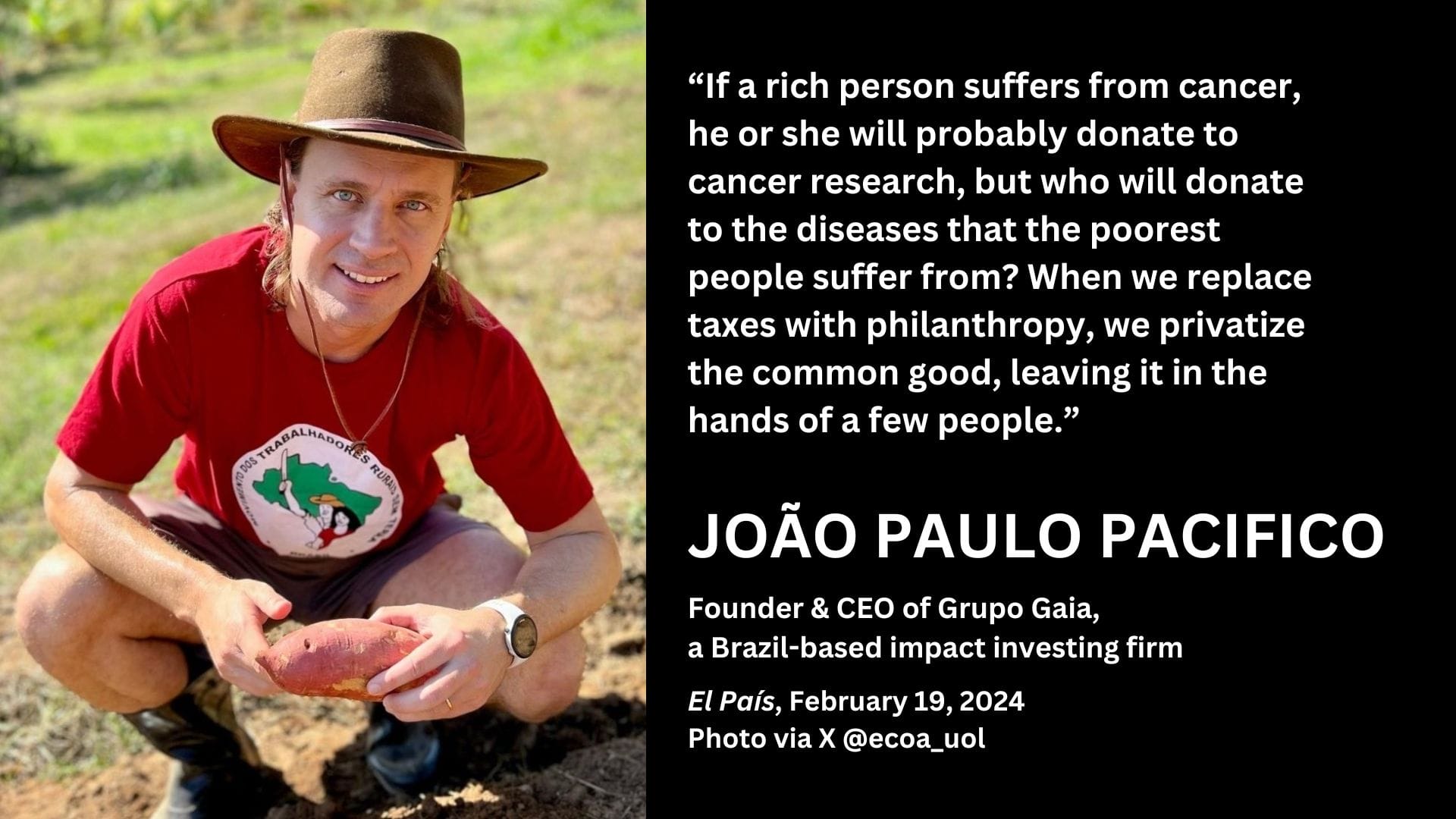
Naiara Galarraga Gortázar, João Paulo Pacifico, millionaire: ‘Replacing taxes with philanthropy is the privatization of common well-being,’ El País. An outspoken Latin American mega-millionaire sees the status quo on taxation as exacerbating economic inequality and threatening democracy. |
Stop Private Jet Expansion Webinar on March 6, featuring Inequality.org’s Chuck Collins, register here. |
Matthew Sitman, Sam Adler-Bell, and Jennifer Burns, Milton Friedman and the Making of Our Times, Know Your Enemy. A discussion of a new biography of Nobel Prize-winning economist and libertarian intellectual Milton Friedman. |
|
|
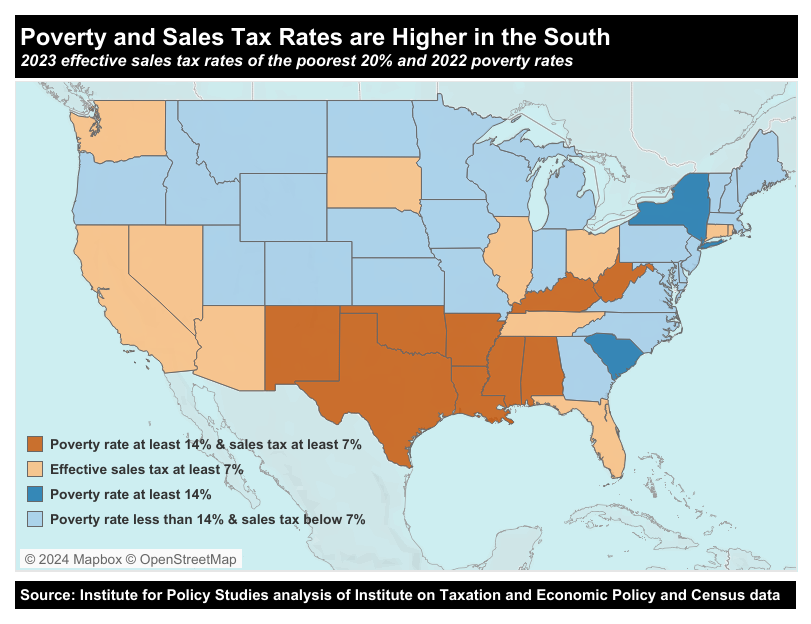
States that rely most heavily on regressive sales taxes are concentrated in the southern part of the United States. Many of them — not coincidentally — also have high poverty rates. An Institute for Policy Studies analysis of Institute on Taxation and Economic Policy and U.S. Census Bureau data reveals that nine states have both a poverty rate of at least 14 percent and a sales tax burden on the bottom 20 percent of income earners of at least 7 percent. For an interactive version of this chart and other charts on taxes and inequality, check out the link below.
|
|
|
Inequality.org runs on the loving labor of a small team of researchers, writers, and advocates. More than anything, all of us involved believe deeply in the power of everyday people to come together to accomplish something big! We’ve built this operation around our weekly newsletter, and our paid subscribers make this newsletter possible with monthly donations. Join the ranks of our paid subscribers: Start today. |
|
|
Inequality.org | www.inequality.org | inequality@ips-dc.org Institute for Policy Studies
1301 Connecticut Avenue Ste 600
Washington, DC 20036
United States
Managing Editor: Chris Mills Rodrigo
Co-Editors: Sarah Anderson, Chuck Collins, Bella DeVaan, and Sam Pizzigati
Production: Bella DeVaan and Chris Mills Rodrigo |
|
|
|